
From Phone-Based Orders to Structured Operations
From message-based work to structured operations – small business process improvement
Overview
A summary of a recent business process improvement work in practice
Situation
Orders, stock, and pricing were being managed across messages, notes, and spreadsheets, with no single place to see what was happening. As demand increased, keeping track of work became more time-consuming and less reliable.
In practice, this looked like:
“I’m constantly juggling, working long hours just to fulfill”
Change
A simple, low-cost operational system was introduced to centralise order capture, prioritisation, and production tracking in one place.
This created a structured way to capture orders, prioritise work, and track progress across the business. The system was designed, implemented, and operational within two days. It replaced scattered messages and manual tracking with a single, consistent workflow.
In practice, this looked like:
“Solved long-standing operational gaps with a fully functional, automated system -delivered and operational within two days.”
Outcome
The business moved from reactive, time-consuming coordination to a controlled, structured way of operating.
Business Process Improvements:
This created a foundation for growth without increasing operational strain or overhead. As demand increases, the structure allows the business to handle more work without a corresponding increase in complexity or effort.
“I’m in control, I know where I am”
How It Was Delivered
A detailed account of a recent business process improvement work in practice.
Executive Summary
An established artisan bakery with three years of steady trading had outgrown its informal systems. With a growing customer base built entirely through social media and an ambitious expansion into events catering and decorations services, the client needed an operational foundation that could support scale – but within the constraints of a sole trader budget and without requiring technical expertise to operate.
Inalyscope designed and delivered a fully relational six-table operational database in two days, resolving long-standing gaps in product costing, stock management, order tracking, and pricing. The solution automates what previously did not exist – from ingredient-level cost rollups to real-time margin modelling – and includes a live operational dashboard, a customer order management system, and a documented user guide. The client is now trading with full cost visibility, structured order management, and a platform architected to grow with the business.
Client Background
A sole trader artisan bakery with three years of consistent trading, operating from a home kitchen and building a loyal customer base entirely through organic Facebook and Instagram activity. The business specialises in celebration cakes and bespoke treats, with strong repeat custom and a growing base of new enquiries demonstrating clear and sustained market demand.
The client is now actively pursuing a strategic expansion into event decoration services, a natural evolution of the existing offer, but one that introduces greater complexity in quoting, fulfilment, and supply management. The client manages all business functions personally, is not technically advanced, and operates within a sole trader budget, making simplicity, automation, and low cost fundamental requirements of any proposed solution.
The Challenge
Informal systems that had functioned adequately at low trading volume had become a structural barrier to growth. Four interconnected gaps were identified:
The Solution
Operational Database:
Inalyscope designed and built a fully relational operational database containing six interconnected tables. The selected software offered accessibility for a non-technical operator, coupled with relational data capabilities and API readiness for future application development. The platform constraint was a deliberate, budget-conscious choice; the architecture was not.
A simplified view of how ingredients, products, orders, and customers are connected.
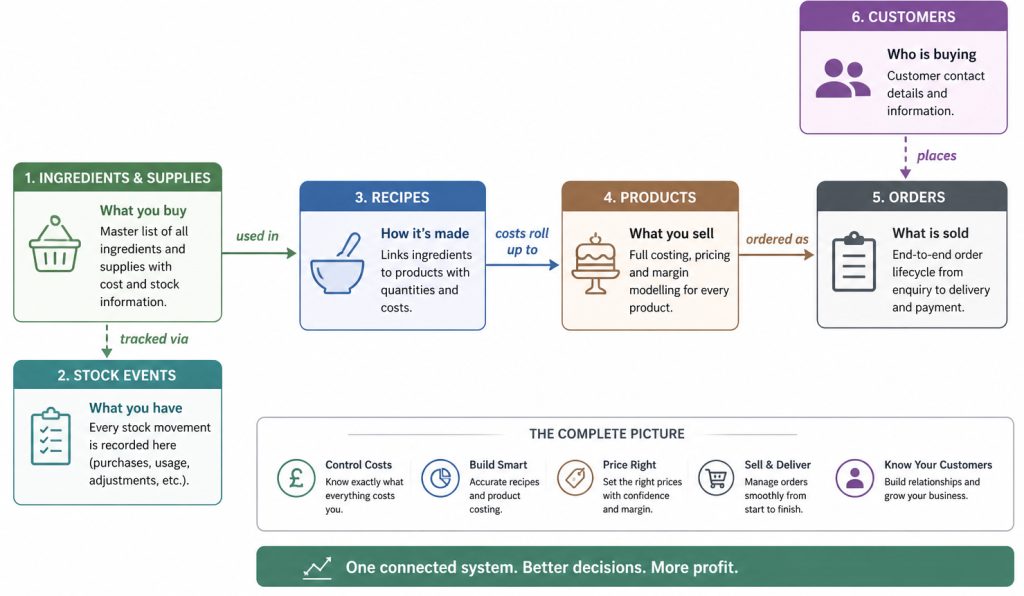
Everything is connected — from cost through to customer delivery.
Operational Dashboard
A single-screen operational dashboard was configured and delivered, giving the client immediate visibility across three critical areas without navigating individual tables:
Automated Capabilities
Delivery & Training
The full solution — database, dashboard, and documentation — was delivered within two working days. Alongside the technical build, Inalyscope produced a structured user guide covering all six tables, field-by-field guidance, and clear operational instructions tailored to a non-technical sole trader. The guide covers:
The client was walked through the complete solution on delivery, with all data populated and tested using real ingredient costs and live product pricing before handover.
Outcomes
|
Full cost visibility |
Every product has a fully calculated, automatically maintained cost, ingredients, labour, and packaging – with no manual calculation required |
|
Evidence-based margins & pricing |
Real-time margin modelling replaced intuitive guesswork – the client sees the financial impact of any pricing decision before committing |
|
Real-time stock management |
Stock tracked dynamically with purchases, usage, wastage, including automatic reorder alerts – stock failures flagged before they become production problems |
|
Structured Order Management |
Every order is tracked from enquiry to delivery, with payment status, deposit management, and customer contact at a glance |
|
Operational dashboard |
Single-screen business overview replacing fragmented information across notes, memory, and social media messages |
|
Future-ready Architecture |
A platform built to scale – not a workaround to be replaced |
Scaling Options – when the time is right
The database has been architected with the client’s growth ambitions in mind. The following scaling options are available without any structural rebuild -the data foundation is already in place.
Operational Today
The database provides a fully functioning operational backbone supporting both the existing celebration cake and treats business and the emerging events and decorations service from day one.
Short-term
The database is fully API-documented and structured to accept order form submissions directly from a business website, ensuring customer enquiries automatically land in Orders and Customers with no manual re-entry.
Medium-term
Customers could browse the product catalogue, configure orders, receive instant cost estimates, and submit bookings directly, removing the need for manual enquiry handling. All submissions feed the existing database, using the product costing model already in place. Front-end development only, with no data rebuild required.
Long-term
As order and customer history accumulate, the database is positioned to surface insights into peak demand periods, best-performing products, customer lifetime value, and margin trends.
“The foundation built today is a platform to be built upon.”
All client data anonymised in accordance with GDPR principles